Friday, September 10, 2010
Creativity followed by Innovation
Thursday, September 9, 2010
Creativity "Complimenting" Innovation
I don't see it as being creativity vs innovation but creativity helping innovation. The two don't compete with one another, they much more compliment one another. Being creative is introducing something new and original and being innovative is merely the same. What really grabs people's attention are new things. If its barely old or really old its still old and the new is what grabs and attracts attention. You want someone to always look at your site, do something new that they have to come to you for. Create something that will cause someone to want to compete with you. Leading to new creativity and innovation.
Apple created the iphone which was the first true touch screen phone with fingers instead of a stylus. It revolutionized the cell phone market and created a new genre for smartphones. It was a creative and innovative idea that demolished all other cell phones in terms of features and performance and styling. Now companies are trying to compete and become more creative and innovative than apple was. It creates a very competitive market for consumers and benefits the consumers. The most popular price for the high-performance touch screen phones are $200. Not many companies jump over that line seeing as it is a good number to attract buyers and still generate profit. All this is due to creativity and innovation by one company generation more creativity and innovation from another company to benefit the consumers.
Tuesday, September 7, 2010
This Week's Assignment
Read Marcel Duchamp's "The Creative Act":
You can find it all over the internet... Marcel Duchamp wrote an essay called "The Creative Act" There is a copy on this page: http://www.iaaa.nl/cursusAA&AI/duchamp.html
Watch:
Charles Leadbeater on Innovation: http://www.ted.com/talks/lang/eng/charles_leadbeater_on_innovation.html
Resource Depletion: The Result of Poor Technological Interfacing
When efficiency is greatly accelerated on one end of a process, it seems to be lost in another part of a greater process. The efficiency lost may be irrelevant when considering only a small part of the life of an object; in this case, production. In the long run this unbalance has revealed itself.
Overproduction of a systematically generated and adaptable product is meant to fit the rigidity technology to the whim-prone, accident-prone, analog nature of human beings. In the United States we can buy and use resources in various wasteful and ridiculous ways, and technology has deliberately made this possible. Incredible efficiency in production, without efficiency in consumption, ends up using the systematic waste of resources as a way to more conveniently interface technology with its human application.
By not designing every product's purpose from start to end, but instead creating standardized, mass produced products, efficiency is gained in production, but it can be lost equally in distribution and consumption.
This puts a responsibility on designers of not only the products and their methods of production, but the designers of the systems of their attainment and distribution. One of our new responsibilities as designers is to consider ways to combat the imbalance of mass production and consumption, and its symptoms.
One solution is to find ways to make our 'artifacts' more valuable, complex, flexible in use, and durable in themselves--relying on making the product more useful to humans rather than 'making-up' for quality with abundance and interchangeability.
Monday, September 6, 2010
The Digital Age
Perhaps this connection between machines can be felt even now. As the author suggest machines have caused humans to become increasingly meticulous about their, work, looks, and every day life. A connection that can be made between something organic that humans have made into to a mechanical process, is one that is the most important for human survival. That connection is food processing. In America there are thousands of cattle ranches with millions of cows that are treated as a number in a computer system. Just like the customers that eat their processed meat. It is no longer about what is healthy for human consumption it is now about how fast food can be produced and how fast it can be consumed. Our entire world is about how fast things and be transferred and consumed and how efficiently those things can be done. Computers and the digital age we live in has created an entirely new human experience in the way that we communicate and interact with each other.
Digital Analog
Relevance of the Shannon Weaver Model

Visually Communicating & the Shannon-Weaver model
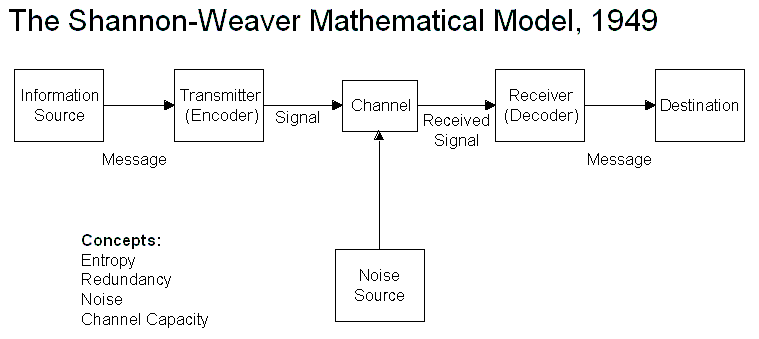
This link illustrates the Shannon-Weaver model:
http://www.shkaminski.com/Classes/images/Shannon-Weaver%20Model.gif
Visual designers face many problems while trying to create a strong visual message. I separate them into three categories that stem from the Shannon-Weaver model. They are listed below.
•Comprehension Problems: Before the message has been generated, all you have is an information source, or facts. The interpreter of the facts could have simply misinterpreted the facts. That means your effort to visually solve a problem is flawed before its inception. The same is true with the opposite end of the model. The person who is receiving the message just may not “get it”.
•Transmitter Problems: You could have a strong message, but deliver it the wrong way. If you’re selling a quality product, would you really want to print it on cardboard paper?
•External Problems (Noise): You could have done everything perfectly, but things beyond your control could interfere with the message being delivered the way that you intend. Imagine sending a beautiful mailer to constituents, asking them to vote for a candidate. What if the postal worker had to deliver the mailers during a storm, and they got to the constituents damp, dirty and wrinkly?
These are just a sampling of situations you have to think about while designing and communicating.
Digital vs. Analog
Is technology evolving faster then we are?
As designers we need to be aware of our analog audience and make the user experience as easy as possible. We need to make the digital world more flexible to meet the needs of our audience. Ideally a designer should be able to find a perfect balance between analog and digital, but that balance is different for each person who experiences the end product. Who do you make your target audience so you can satisfy the most people?
It is easy to see through the generations that not all people have been able to keep up with digital technology. Generations who grew up without a computer being a standard piece of technology have a harder time adapting and then keeping up with the progressions. There has to come a point in time when people get fed up with constantly having to keep up with technology.
Shannon-Weaver Model
First, I am a Medical Illustrator who electronically and/or non-electronically communicates complex medical and scientific information. One wrong interpretation concept can effect a falsify information for others. Therefore, as sender, I have to have the basic biology knowledge, and I have to convey the concepts in a meaningful, aesthetic, and understandable manner to the receivers through the use of both the computer and the traditional mediums.
Second, as a Cosmetologist, consultation (non-electronic communication) is key understanding of what the clients’ need in order to perform the proper service on them. If the client and I don’t have the basic understanding of the communication, the effect of the haircut or hair color will be a disaster and can even damage the clients’ hair.Humans verses Computers
Since computers are programmed by human beings, they will only do what you tell them to do. To a certain extent computers are dumb because without our assistance to help them function they would be of no help. A computer is a tool made to help us communicate our thoughts through the help of technology but instead it has replaced our ability to think for ourselves. The article speaks of generations growing upon generations in knowledge and may take years to be a well educated citizen. People abuse technology and at the rate we're going future generations will not become well educated citizens because they will be unable to think for themselves.
Sunday, September 5, 2010
Shannon Weaver Model
I think designers should have a clear understanding of what happens to the information, However I do not think they need to have in depth knowledge about the subject. The basic way of using the Shannon Weaver Model will help the designer see where their design ends up from where it started.
Communication Model
Phone calls, text messages, e-mails, etc. are all forms of communication. Each uses the Shannon-Weaver model, which includes a sender and a receiver. This model conveys a basic concept of how communication takes place.
It is important for designers to understand the Shannon-Weaver model because it is the concept of how electronic communication works. Whether or not we use the Shannon-Weaver model today, others who have created new models that allow electronic signals to travel in a much faster period of time, referenced the Shannon-Weaver model.
It is important for designers to understand the Shannon-Weaver model, just as it is important for doctors to understand basic principles of biology. This model set a foundation for where we are today.
Shannon-Weaver Model
Maybe it's because my generation grew up in the digital age, where we're constantly surrounded by the that big red Easy Button. Perhaps "pointless" is a strong word but do we need to know much more than where the information is from and where it needs to go? We have an objective, we execute, hopefully we'll avoid any whisper down the lane-type distractions, and we're done.
Friday, September 3, 2010
The Ever-Increasing Pace of Change
Norman states “Scientists no longer are able to keep up with advances even within their own field, let alone in all of science. As a result, we are in the age of specialization, where it is all one person can do to keep up with the pace in some restricted domain of endeavor. But with nothing but specialists, how can we bridge the gaps?”
I chose to go back to grad school because I noticed that businesses need specialist. You cannot be just a graphic or web designer and expect to get a job. You have to have a specialized skill that will set you apart from the crowds. Recently while I was job hunting, I noticed that most jobs expect you to be able to handle a large number of responsibilities on top of being some sort of digital specialist. This is a frustrating realization, but this is the reality of our time. With digital replacing everything that was once analog and simple, we, as designers, need to bust our asses to stay afloat in this ruthless world.
Working in such a digital realm, it is crucial to understand the world around us. This forces us out of our comfort zones as analog beings it pushes us into this new territory. Two quotes from Norman sums this new territory up: “The real problem with being digital is that it implies a kind of slavery to accuracy…” and “People do best with signals and information that fit the way they perceive and think, which means analogous to the real world. Machines do best with signals and information that is suited for the way they function, which means digital, rigid, precise.” I feel that designers are forced to become digital beings, even if we are not completely comfortable stepping away from a more analog world. We must learn to adapt this new way of thinking and living or else we will not be able to survive in the world of design.
Analog Beings in a Digital World
So how do flexible, analog beings learn to live in a society that is riddled with these calculating, unforgiving machines? Are current situation has show us that we cannot continue on our current path. Something has to change because right now we are being forced to live and think in ways that are unnatural. The article had a wonder solution in that we need to create a better, more natural way of interacting with computers. This is the challenge we face as designers. How do we make our users experience more "human like"?