Read:
http://avc.blogs.com/a_vc/2007/05/what_trumps_ema.html
Write:
Select a blog that posts at least once a day on a topic you like. Read it all week.
Blog about your experience reading the blog for an entire week. Consider what channels of communication are most appropriate for different types of information
Tuesday, September 28, 2010


Hypermedia, Otlet and Bush
Hypermedia allows the user to decide how and when they will interact with the information given. The user can navigate through information, play or turn off audio, videos and look at pictures without having an author tell you how and when you will be doing so.
After watching the video I found it kind of bizarre how Otlet was able to think these ideas almost as accurate to where the internet has become. The way that information is gathered together and how an individual can search and sort through this information so easily online is very similar to how Otlet had envisioned. I understand in todays world we think of futuristic ideas and say how awesome it would be. Then ten or twenty years later the idea has come to life. However, back in 1934 I can’t imagine an individual even thinking of such advanced technology.
As for the article As We May Think, I found it most impressive that Bush was so advanced in his way of thinking. Bush lived in the past, but was thinking for the future. Many individuals today do just what Bush did years ago.
After watching the video I found it kind of bizarre how Otlet was able to think these ideas almost as accurate to where the internet has become. The way that information is gathered together and how an individual can search and sort through this information so easily online is very similar to how Otlet had envisioned. I understand in todays world we think of futuristic ideas and say how awesome it would be. Then ten or twenty years later the idea has come to life. However, back in 1934 I can’t imagine an individual even thinking of such advanced technology.
As for the article As We May Think, I found it most impressive that Bush was so advanced in his way of thinking. Bush lived in the past, but was thinking for the future. Many individuals today do just what Bush did years ago.
As we may think
It really is amazing how an article written 75 years ago can so accurately describe the progress of technology today based on the technological triumphs of his day. Bush's main contemplation was how much the world would benefit from a device that could store all of the worlds information and allow instant retrieval of that information. Sound Familiar? Sounds like what the internet has become. He was able to brainstorm a version of the internet base on the technology of microfilm which looked like a small movie reel of film that contained a page of information per cell.
The fact that this guy was able to look at his present technology and was able to figure out, to a degree, how it would grow and change is something that we as digital designers should make a habit of. Understanding current technologies and what is the next logical stage in there growth willl help us prepare to use the tools of the future.
The fact that this guy was able to look at his present technology and was able to figure out, to a degree, how it would grow and change is something that we as digital designers should make a habit of. Understanding current technologies and what is the next logical stage in there growth willl help us prepare to use the tools of the future.
Monday, September 27, 2010
Hicks Law - Not Hypermedia
Hicks Law impacts my decisions as digital designer because time is of the
essence. It helps examine the relationship between the speed of processing under
conditions that require your divided attention. You want to bring visitors back to
your websites again and again, but you must entice them the first with ease and
interaction. Hicks Law is valuable to me as a designer because if I create a web page,
and it is too darn complicated, not engaging or has nothing for the visitor to interact
with, they are going to leave and seek for stimulation and information elsewhere.
You want to keep the visitor moving and provide easy navigation throughout the
website.
A link that may be helpful to further explain this is found at Wiki. Mental Chronometry is more of the psychological understanding of how the mind functions and processes information
and reaction time.
essence. It helps examine the relationship between the speed of processing under
conditions that require your divided attention. You want to bring visitors back to
your websites again and again, but you must entice them the first with ease and
interaction. Hicks Law is valuable to me as a designer because if I create a web page,
and it is too darn complicated, not engaging or has nothing for the visitor to interact
with, they are going to leave and seek for stimulation and information elsewhere.
You want to keep the visitor moving and provide easy navigation throughout the
website.
A link that may be helpful to further explain this is found at Wiki. Mental Chronometry is more of the psychological understanding of how the mind functions and processes information
and reaction time.
The Value of an Idea
Perhaps I’m not the most attentive reader, but I didn’t even catch that As We May Think was written in 1945 until I paused while reading & glanced at the blog entries. Wow… Vannevar Bush’s visions are very impressive. This essay describes many devices that we use today.
I used to think that if we dropped someone from the past into our world, they would have a heart attack from simply looking at our world today. This article made me realize that people from the past have been imagining the world we live in before our parents were born. So what makes people so imaginative? Why are people like Vannevar Bush thinking about & describing the future? A lot of if comes from our desire to make our world easier to live in: we’re problem solvers. Bush noted early in As We May Think that the inventions of the past have focused on improving the physical condition of man. Once we've satisfied our basic physical needs, we can work on tools that will improve our intellectual condition.
Why is this article relevant? I think the take-away message is to note the value of an idea. All of our ideas may not be executable in our lifetimes, but our ideas may serve as the blueprint for some device for our children and grandchildren.
I used to think that if we dropped someone from the past into our world, they would have a heart attack from simply looking at our world today. This article made me realize that people from the past have been imagining the world we live in before our parents were born. So what makes people so imaginative? Why are people like Vannevar Bush thinking about & describing the future? A lot of if comes from our desire to make our world easier to live in: we’re problem solvers. Bush noted early in As We May Think that the inventions of the past have focused on improving the physical condition of man. Once we've satisfied our basic physical needs, we can work on tools that will improve our intellectual condition.
Why is this article relevant? I think the take-away message is to note the value of an idea. All of our ideas may not be executable in our lifetimes, but our ideas may serve as the blueprint for some device for our children and grandchildren.
Hypermedia
Hypermedia has changed design by simplifying the way people find all types of media. The world wide web has attached strings to books, magazines, newspapers, video, audio and more and brought them back to one spot for people to control it from. You simply search for it on Google for example and it pulls them in for you to sift through. If you get a video when you wanted an article you simply scroll through links or retype your search until you find it. It takes only a few seconds versus actually searching the world (sans web) for the information you want. It has changed the design of the way people search, from scattered to collected.
I think we are better off with it because it doesn't change the information, just gathers it. It lets all people access the same information. This may be harmful because not all information could be official. Also people could start to develop the same designs or work because they all have the same exact resources. It's a stretch, but definitely a possibility to consider. But overall, i think it is very convenient and efficient.
I think we are better off with it because it doesn't change the information, just gathers it. It lets all people access the same information. This may be harmful because not all information could be official. Also people could start to develop the same designs or work because they all have the same exact resources. It's a stretch, but definitely a possibility to consider. But overall, i think it is very convenient and efficient.
Hypermedia
Hypermedia has changed design quite a bit in recent years. If you look at the way people use blogs as gateways to information, lots of different people with the right resources can advance themselves as designers. A quality design blog will usually contain a wealth of information (inspiration, important design trends, tutorials, etc.) that anyone can use to keep up to date with the extremely fast evolving interactive design field.
One blog I go to in particular offers inspiration from some of the best designers in our field with links to their work/websites. It also uses a unique way to present information on trends and news (http://abduzeedo.com).
One blog I go to in particular offers inspiration from some of the best designers in our field with links to their work/websites. It also uses a unique way to present information on trends and news (http://abduzeedo.com).
As we may think
As We May Think was a very interesting acticle and it defiantly relates to digital design and what we talk about in this class. Written by Vannevar Bush back in the 1940's about tech and what is to come and his expectations and how the future was going to be like. During the article for example they Mr.Bush talks about cameras and film. Films and images have come so far and this isn't the only way to convey this kind of information anymore so to make predictions about this kind of thing is almost impossible because this field and its devices are so rapidly changing. It was interesting to see what Bush thought about and what was to come even way back then. I agree with the other student when they said this relates to our first assignment where we said how technology will be in the future but whose to say that our ideas wont be blown out of the reality of what it will be, its interesting to think about.
This relates to digital design because as digital designers our tools we use and how we design is always changing and its hard to know what direction things will take. The world is changing everyday and the technology is moving even faster almost to the point where we cant catch up(in a way). If you focus on one thing in your design life/career you are pretty much doomed to fail because an industry or a technology can be destroyed in one month and something new can take over, if your not well rounded and ready to evolve with the industry you are doomed to fail. Its sad to say but if your not well rounded in this kind of market I think it will be impossible to find a job. I believe this article is saying you need to be flexible and its the only way to progress, all in all keep an open mind
This relates to digital design because as digital designers our tools we use and how we design is always changing and its hard to know what direction things will take. The world is changing everyday and the technology is moving even faster almost to the point where we cant catch up(in a way). If you focus on one thing in your design life/career you are pretty much doomed to fail because an industry or a technology can be destroyed in one month and something new can take over, if your not well rounded and ready to evolve with the industry you are doomed to fail. Its sad to say but if your not well rounded in this kind of market I think it will be impossible to find a job. I believe this article is saying you need to be flexible and its the only way to progress, all in all keep an open mind
Hypermedia
When I first started researching "hypermedia", I thought all it was referring to was the idea of objects linking to more information, rather than text linking to more information. Pretty simplistic. But as I was reading other blogs, I realized I should be digging a little deeper.
Nowadays we're just bombarded with information, whether we seek it out or not - information overload is something we've become accustomed to. With that, became new ways of relaying that data to readers. Think of it as a business - as the marketer of Frosted Flakes, do you want your cereal box to be black and white and sitting on the bottom shelf? No. You want your product to stand out, to be noticed and with all that competition we need to make an impact.
Cereal design/placement is similar to digital design. There are millions of website and depending on your business, hundreds or thousands of competitors. Our designs, information architecture, and usability must make a statement in order to compete in the marketplace. If all of my competitors link to social media, then mine must too. But done better.
Nowadays we're just bombarded with information, whether we seek it out or not - information overload is something we've become accustomed to. With that, became new ways of relaying that data to readers. Think of it as a business - as the marketer of Frosted Flakes, do you want your cereal box to be black and white and sitting on the bottom shelf? No. You want your product to stand out, to be noticed and with all that competition we need to make an impact.
Cereal design/placement is similar to digital design. There are millions of website and depending on your business, hundreds or thousands of competitors. Our designs, information architecture, and usability must make a statement in order to compete in the marketplace. If all of my competitors link to social media, then mine must too. But done better.
Vannervar Bush's As We May Think
I believe that we were asked to read this article because it is about the future of technology and how man receives, and stores information. Seeing as the age we currently live in is often referred to as the information age As We May Think is a fighting article for the class. What I found most interesting is how forward thinking Bush was for his time. Organizing massive amounts of information and consolidating it was most likely a far fetched idea in 1945. However humanity has been able to consolidate and recorded information just as Bush urged scientist to do after WWII. Humanity was able to do so 10 times the amount Bush could have possibly perceived. With the creation of the internet it is possible to find any type of information that you could possibly need.
This ability to find any kind of information and being able to archive your own personal information quickly and easily relates to what Bush had foreseen man to be able to do. For example we now have digital cameras that can take hundreds, even thousands of photos and quickly up load them on to a computer within a matter of minutes. In Bush’s day and age to took hours just to develop one picture. Not to mention the time it took to develop films. I would say that Vannevar Bush’s ideal about creating a way for massive amounts of information to be archived has been fulfilled to an extent he never thought possible.
This ability to find any kind of information and being able to archive your own personal information quickly and easily relates to what Bush had foreseen man to be able to do. For example we now have digital cameras that can take hundreds, even thousands of photos and quickly up load them on to a computer within a matter of minutes. In Bush’s day and age to took hours just to develop one picture. Not to mention the time it took to develop films. I would say that Vannevar Bush’s ideal about creating a way for massive amounts of information to be archived has been fulfilled to an extent he never thought possible.
Hypermedia
As I read I learned hypermedia is an extension of the term hypertext. This is a system in which various forms of information, such as data, text, graphics, video, and audio, are linked together by a hypertext program. A prime example of hypermedia is the World Wide Web. Hypermedia can be developed in a number of ways. One can write programs that link data or use multimedia software to create a special hypermedia application.
The iphone is a great example of hypermedia. It brings and links all these technologies together and creates a multi-use device. For example when the user buys an app with their iphone all forms of hypermedia are combined, linked and at the users exposure.
The iphone is a great example of hypermedia. It brings and links all these technologies together and creates a multi-use device. For example when the user buys an app with their iphone all forms of hypermedia are combined, linked and at the users exposure.
As We May Think
The article “As We May Think” wrote by Vannevar Bush is interesting. He describes the use of technology and science to develop and recover knowledge for research and human development. He talks about the progress of different technologies and the use of different media like photography, fax, computer, compression of information or content, and voice recognition. All these technologies function are currently in a computer or are will developed in the future.
One example, when he refers to “the camera of the future,” he describes the small digital camera we have right now. The ability to take 100 pictures or more, speed the process, and not have problems with the resolution. These are some characteristics of the digital camera today that is not exited before.
Please give us some example topics of your last year class. Thank you!
HypeMedia
HyperMedia has a massive effect on everybody, particularly designers.
There are both positive and negative ways you can look at the effects of Hypermedia.
On a positive side, hypermedia is constantly exposing us as designers to massive amounts of different material. This constant exposure to design allows us to be constantly inspired by others work. We are indefinitely improving on each others creations.
On a negative side, we are less original with our work because we are constantly influenced by others work, whether it is conscious or not. We look at different websites everyday, and this will inevitably come out in our work one way or another.
As We May Think
After reading this article and some of the blogs other people have already wrote I do agree with Allison and Alexa. The way we think things are going to happen never do happen that way. Since this article was written so long ago some of the things the author states that he thinks will happen we obviously see they did not happen. When we talked on one of the first classes we had said what we think the future will be like, most likely more than half of the ideas that we had talked about will not happen or will end up being completely different than what we anticipated.
Things change so rapidly that when we think some big might happen they might not actually. Understanding how quickly technology changes helps you understand how long it might be before soemthing major actually does change. For example when I was little things seemed to be changing all of the time but I had no idea how quick things would actually change and I always thought I would never get to learn how to drive because I thought something different would be out before I was able to. The author really does have it right when he titles the article "As we MAY think"
Things change so rapidly that when we think some big might happen they might not actually. Understanding how quickly technology changes helps you understand how long it might be before soemthing major actually does change. For example when I was little things seemed to be changing all of the time but I had no idea how quick things would actually change and I always thought I would never get to learn how to drive because I thought something different would be out before I was able to. The author really does have it right when he titles the article "As we MAY think"
Hypermedia
Hypermedia, in my opinion, changed the way people design for the web, or anything interactive. The ability to present and gather information in a non-linear format allows the user to make his/her own decisions, rather than just follow the directions given by the designer. I think this is a good thing because it allows for a generally more free-flow usability experience. For example, if one goes on the computer to access the web, "googles" something, and doesn't like the result they receive, they can simply click on a different link. Hypermedia has also made the information gathering process streamlined and more enjoyable, rather than a hassle.
Personally I would much rather just hop on the internet to find anything I could possibly need, whether it be video, audio, or text, rather than spend hours sifting through a Libraries shelves. To be honest I only used the books in the library once, and it was because the professor required our report to be done with book based sources. It's almost as if hypermedia has allowed me to no longer need to do any research at all using books, since everything is so conveniently linked together on the internet.
As We May Think
After reading As We May Think, I realize that technology has been rapidly evolving in the same way for many many years. This article was written in 1945 and it is clear that the author had no idea what was actually in store for the future. What they were doing in 1945 was very innovative but looking back on it now some of their techniques are not even used any more. One example that was discusses was the evolution of film for cameras. Film has come a long way through the years to what we know it has now, but now it's not even the preferred way to record a picture. This proves that you can't predict for the future because things are changing so rapidly.
This article is relevant to digital design because we are always changing and improving what we already have and many programs we use today will eventually be obsolete. Our entire society is rapidly changing and the technical world is moving even faster. We, as designers, need to be ready to change with the times and never get too comfortable with just one thing. We need to have a broad look on design and if we specialize ourselves in something too specific we may find ourselves without a job down the road. If you graduate with a design degree and then don't continue to educate yourself you will not be an efficient designer in a few years. This article really points out that you have to be flexible and willing to change.
This article is relevant to digital design because we are always changing and improving what we already have and many programs we use today will eventually be obsolete. Our entire society is rapidly changing and the technical world is moving even faster. We, as designers, need to be ready to change with the times and never get too comfortable with just one thing. We need to have a broad look on design and if we specialize ourselves in something too specific we may find ourselves without a job down the road. If you graduate with a design degree and then don't continue to educate yourself you will not be an efficient designer in a few years. This article really points out that you have to be flexible and willing to change.
"there are signs of a change"
After reading the article "As We May Think" by Vannevar Bush, it makes you realize that the future that you think is going to happen, might not due to how things (items, theories, technology) evolve. No matter what technology is going to advance and it's going to have an effect on how the future develops and reacts. These evolutions are from everything, photography science, recordings, and even math.
Throughout the article Bush looks back and talks about how things have gradually changed over the years and how they have an impact on the future.
Throughout the article Bush looks back and talks about how things have gradually changed over the years and how they have an impact on the future.
Sunday, September 26, 2010
Hypermedia
Hypermedia has definitely changed the world, and I feel that it’s a change for the better. Hypermedia is generally defined as “a logical extension of the term hypertext in which graphics, audio, video, plain text and hyperlinks intertwine to create a generally non-linear medium of information”. The World Wide Web is probably the best example of hypermedia. The web brings all types of mediums together to give the user a plethora of information. Paul Otlet, the father of information science, wrote several essays on how to collect and organize the world's knowledge. His vision was to house all the world’s knowledge in one general spot and a person would be able to search through this data in an easy way and get all the information they needed and in any form they wanted (visual, text, audio, etc). His model for this plan is very similar to how the internet works.
Hypermedia has definitely changed the world and I feel it’s a change for the better. An information system like the internet has brought information and knowledge into the hands of so many people. Before the internet became such a commonplace thing, the best way to get information was probably going to the library to search for knowledge. While I loved the library growing up, I must admit that hypermedia has made my life so much easier. Doing a book report when I was in grade school involved going to the library, trying to find a couple of books that contained pertinent information, going home and browsing these books and extracting the necessary information for the report. There are several problems with this method: a) books weren’t always checked-in b) sometimes it was hard to know what to search for a book under c) lots of time was spent d) library hours. Nowadays, one is able to go to their preferred search engine and try their luck searching thousands of documents in a span of mere seconds. Hypermedia also gives you a variety of medias, which is very useful because everyone learns differently.
One way hypermedia has changed design is that with knowledge so readily available, untrained people are able to become “designers”. This can be viewed as a good thing or a bad thing. For example, I was really never formally trained as a web designer; I had a basic web 101 class, but that was it. But with access to hypermedia like the internet, I was able to search for specific knowledge that allowed me to teach myself web design. Hypermedia gave me access to videos, text, pictures and audio which really aided in my self-teaching. Buying books and reading through them did not help at all. If it weren’t for hypermedia, I’d still be a graphic designer instead of running the web department at work. There is also a down side to this access of knowledge. Anyone can get on the web and create a wordpress blog or something similar. They can teach themselves some simple css to customize their blog. Then they consider themselves a web designer because they were able tweak a blog template. With so many self-declared designers out there due to the easy access of hypermedia, it has definitely changed the field design and perception of those actually in the industry.
(image taken from http://9gag.com/gag/37798/)
As We May Think
After reading "As We May Think," it reminds me of one of our first classes where we were asked to think of ideas to be implemented in the future. What I got out of this article was that the process in which we do things are always changing. From past to present and to the upcoming future. Bush talks about the camera first and how lenses and shutters change the way we take pictures. New ways of taking pictures are available. It used to only be film but now its film and digital where one is favored more than the other. Bush continues to reminisce in new and old forms of technology which is something we are all a part of today.
We all tried to predict what the future was going to do with the technologies available. But when the technologies change, so does the future. It's not always the products that evolve, it's also the processes involved and the technologies used. Can something that has been improved so much become a new invention? I believe so.
We all tried to predict what the future was going to do with the technologies available. But when the technologies change, so does the future. It's not always the products that evolve, it's also the processes involved and the technologies used. Can something that has been improved so much become a new invention? I believe so.
Assignment for 9/28
Project Topics are due soon. Email me your ideas.
Read:
Vannevar Bush: As we may think:
http://www.theatlantic.com/doc/194507/bush
http://en.wikipedia.org/wiki/Hick's_law
Watch:
http://www.liveleak.com/view?i=2a1_1221941168
Assignment:
Blog about why you think you were asked to read this article
OR
What has hypermedia changed design? Are we better off with it?
OR
How does Hick's Law impact your decisions as a digital designer?
Read:
Vannevar Bush: As we may think:
http://www.theatlantic.com/doc/194507/bush
http://en.wikipedia.org/wiki/Hick's_law
Watch:
http://www.liveleak.com/view?i=2a1_1221941168
Assignment:
Blog about why you think you were asked to read this article
OR
What has hypermedia changed design? Are we better off with it?
OR
How does Hick's Law impact your decisions as a digital designer?
Tuesday, September 21, 2010
Devalued Intellectual Copy
The copies of intellectual property have been devalued by the digital age. An artist, writer, musician, or other creative person has to expect any work released to the internet to be somewhat devalued in comparison to the actual physical work, or in comparison to the overall value reproductions were awarded in the past.
The entire idea of property has always been flexible. We have to rethink what we define as valuable property , and the actual value of a copy of something. Physical copies of CD's have to become more physically desirable in terms of artwork and actual product to encourage collectors, which has lead to a resurgence of vinyl record releases, which have a higher quality than MP3 sound, larger artwork, and a nostalgic appeal. MP3's must now be viewed more as commercials--no one pays to hear a commercial, but the more people that see or hear it, the better for the originating company and the sale of its physical product, whether that is live performance, art prints, or some other means of earning money.
Success comes from the correct application of the correct idea. The reapplication of existing intellectual property has to be not only accepted, but allowed. As long as it is appropriately creatively altered or used for another purpose, and not an exact copy used for the same purpose.
Monday, September 20, 2010
Intellectual Property
Intellectual Property is always an issue, and the more user friendly the digital world becomes, the bigger the issue gets. It is so easy to put something up on the internet now that anyone can do it. People can sit there and read a quote from a book, go on the internet and claim it as their own. There is a possibility they could get caught and yet there is still a possibility that they wont and people will believe it. So many times I've seen images and quotes that people claim as their own when in reality they just found it somewhere else. It only takes a screen shot, a copy/paste or a file/save to obtain any information you want. Its a free world on the internet and so far no one can figure out how to stop it.
While the people trying to regulate such copyright infringements are getting more clever, so are the people pirating. When I look at some of the mass downloading sites I am in awe at their secretive, clandestine ways of getting you whatever file you want. This is obviously a cycle that will keep happening, so it seems that a new approach is needed. They have already started with things like iTunes (easier access than sites like Napster, with a small fee) or TV channels' sites letting you watch shows online for free (with sponsored commercials). The problem is still very much present, but these help to alleviate the damage done by copyright infringements. Still I fear they are going to try something drastic (paying to access sites?) but hopefully this can be solved in a way that is still user friendly (and non expensive) but completely legal.
While the people trying to regulate such copyright infringements are getting more clever, so are the people pirating. When I look at some of the mass downloading sites I am in awe at their secretive, clandestine ways of getting you whatever file you want. This is obviously a cycle that will keep happening, so it seems that a new approach is needed. They have already started with things like iTunes (easier access than sites like Napster, with a small fee) or TV channels' sites letting you watch shows online for free (with sponsored commercials). The problem is still very much present, but these help to alleviate the damage done by copyright infringements. Still I fear they are going to try something drastic (paying to access sites?) but hopefully this can be solved in a way that is still user friendly (and non expensive) but completely legal.
The Price of Creativity
I love music; it’s almost an addiction. With my so-called addiction you would think that I spend most of my time in the music stores, anxiously checking in with the clerks about what’s new. Or maybe you’d expect me to be downloading dozens of new releases every Tuesday on iTunes. I don’t do any of that. Searching for free mixtapes, ripping audio content from youtube, and finding albums online is how I get my music. I assume that the majority of my generation does the same thing.
For the consumer, the most obvious benefit of online music sharing is free music. There are some benefits to artists as well:
• Free promo and buzz, especially if your music is good… or really bad.
• Low Production & Distribution Costs. (All you need is some artwork & the digital files).
If your music is given away for free, it’s possible that you could create a new fan base, or at least a fan base that’s larger than what you would have created if your music was only available in stores. To generate income, you would have to rely on touring and selling merchandise. This could provide a decent income to some musicians.
But what if you’re an artist that can’t go on tour? How would you make your money?
Online music sharing really hurts artists that can’t go on tour and sell merchandise. Even bigger name artists are experiencing severe income losses. The behind the scenes people hurt also – songwriters, producers – and everyone else involved in making the music feel as if all of their efforts has gone to waste once a single is “leaked” on youtube.
I’m not sure what my conclusion is in regard to online music sharing. I see that it’s good and that it hurts the artists. While I rarely buy music anymore, I try my best to support good music. Underground music and local music usually receive my monetary support, but some big name artists do as well. When reviewing music, a lot of people categorize music into “download this” vs “buy this”. That should tell you something: Maybe artists should focus their energy on producing quality music that speaks to the soul rather than music that is as temporary as the time it takes to download the file. We’ll see what happens in the coming years. I hope that all parties involved are able to find a balance.
This subject also makes you think about the price of creativity. Some people make millions because of their voices and writing abilities… but are we really supposed to be able to make millions off of that? Let’s give the millions to the people with jobs that are humanitarian in nature. In the digital age, intellectual property is becoming cheapened because it’s so readily available and duplicated. While I think it is wrong to steal from people, sometimes I think it is a good thing that music can simply be stolen. I have a problem with some of these artists making millions for saying ignorant, or maybe just dumb, things. But people love their Souljah Boy...
For the consumer, the most obvious benefit of online music sharing is free music. There are some benefits to artists as well:
• Free promo and buzz, especially if your music is good… or really bad.
• Low Production & Distribution Costs. (All you need is some artwork & the digital files).
If your music is given away for free, it’s possible that you could create a new fan base, or at least a fan base that’s larger than what you would have created if your music was only available in stores. To generate income, you would have to rely on touring and selling merchandise. This could provide a decent income to some musicians.
But what if you’re an artist that can’t go on tour? How would you make your money?
Online music sharing really hurts artists that can’t go on tour and sell merchandise. Even bigger name artists are experiencing severe income losses. The behind the scenes people hurt also – songwriters, producers – and everyone else involved in making the music feel as if all of their efforts has gone to waste once a single is “leaked” on youtube.
I’m not sure what my conclusion is in regard to online music sharing. I see that it’s good and that it hurts the artists. While I rarely buy music anymore, I try my best to support good music. Underground music and local music usually receive my monetary support, but some big name artists do as well. When reviewing music, a lot of people categorize music into “download this” vs “buy this”. That should tell you something: Maybe artists should focus their energy on producing quality music that speaks to the soul rather than music that is as temporary as the time it takes to download the file. We’ll see what happens in the coming years. I hope that all parties involved are able to find a balance.
This subject also makes you think about the price of creativity. Some people make millions because of their voices and writing abilities… but are we really supposed to be able to make millions off of that? Let’s give the millions to the people with jobs that are humanitarian in nature. In the digital age, intellectual property is becoming cheapened because it’s so readily available and duplicated. While I think it is wrong to steal from people, sometimes I think it is a good thing that music can simply be stolen. I have a problem with some of these artists making millions for saying ignorant, or maybe just dumb, things. But people love their Souljah Boy...
Is it Inspiration or Theft...
Copyrighting has and will always be a huge issue regardless of what idea, design, discovery, invention etc. is being protected. We as designers all seek inspiration from the work of others to help assist us in developing our own ideas. Many like to say it's inspiration they search for and others consider it stealing. In all reality getting inspiration from others will help but it can also be seen as manipulating a preexisting idea. As a result the work is not original but redesigned.
For example if you look at the logos below you'll see that University of Georgia logo looks very much like the Green Bay Packers logo. Now would you call this inspiration or theft? In a way copyrighting is a waste of time because we all borrow or get inspired from one another. In my opinion many who copyright their work do so to say they thought of it first. In reality, that person was able to protect the work they basically stole from another. You can choose to call it inspiration or theft but we all do it. No one idea is solely original because as designers we all feed off of one another's creativity, work and ideas.

For example if you look at the logos below you'll see that University of Georgia logo looks very much like the Green Bay Packers logo. Now would you call this inspiration or theft? In a way copyrighting is a waste of time because we all borrow or get inspired from one another. In my opinion many who copyright their work do so to say they thought of it first. In reality, that person was able to protect the work they basically stole from another. You can choose to call it inspiration or theft but we all do it. No one idea is solely original because as designers we all feed off of one another's creativity, work and ideas.

Intellectual Property
The subject Intellectual Property is mentioned in my Marketing and Business Practice Medical Illustration class. My formal professor talks about topics like copyright, transfer of rights, divisibility of rights, infringement, fair use, and international copyright. He tells us that as a designer, you should have some knowledge about these topics, so that you can avoid illegal issues. Frankly, do people really follow the rules? I sure everyone did it at least once or twice in their lifetime, but whether it is intentionally or not intentionally.
For example, Shepard Fairey’s HOPE poster is intentionally copied from Mannie Garcia because he admits copying her photograph and destroying the evidence. When comparing both the photograph and the HOPE poster, they look the same. I think Fairey should have modified it even more or take his own photograph.
I think is fine to copy from others as long as you modify it, so it does not look identical with the original. For example, people tell me, as a novice programmer, I should copy, paste, and modify the code of others and make it your own is the best way to learn how to code. In some sense, our inspiration and learning are come from copying others, and the Internet is the best resource!
Intellectual Property
Intellectual Property in the digital age is a tricky subject. According to Wikipedia, owners of intellectual property are granted certain exclusive rights to a variety of intangible assets. Intangible asset seems to be an oxymoron to me, intangible is defined as “not having physical substance or intrinsic productive value” and “hard to pin down or identify” and asset is defined as “something or someone of any value”. How can one, let alone the law, determine exactly what intellectual property is? Especially in Shepard Fairey’s case, how can one determine how one can interpret a photograph? It’s not like he claimed he took the photo, he merely used the likeness of the image to create his HOPE posters. The context of the two pieces of art are completely different and send different messages. I do understand where the AP and Mannie Garcia are coming from though. They were the inspiration behind Fairey’s work, but if they just inspired, should they get credit? And this is the problem with Intellectual Property in the Digital Age.
The blogosphere reminds me of a modern day Napster. There are millions of blogs out there and lets say half of these bloggers are not any type of digital media pros. They drag and drop images, logos, content, etc. on their blog but re-work it in a way that presents it to their followers as original or from their point of view. Like Napster, blogs are great for start up companies, brands, etc. especially when public opinion of the said product are agreeable because it generates good press and has the potential to boost sales. I feel the people have a problem with intellectual property when their content is used in a way that is unfavorable to the original intent. Like Napster, when content on blogs are used in an unfavorable people start throwing around legal terms and jargon because they don’t like the message.
I think in general, people are open to sharing intellectual property in the digital age as long as the message of the borrowed intellectual property is not harmful to the original owner. When the message changes and hurts or conflicts with the original intent, that’s when lawyers seem to get involved. But the great thing about the looseness of the laws, is that they can be interpreted in many ways. And I personally feel that sometimes, the best work and ideas are created from tweaking something that is already in existence!
Shepard Fairey's HOPE poster
The poster was said to the most efficacious American political illustration since the old Uncle Sam pointing saying "WE WANT YOU". However the poster was deemed apparently perpetuated illegally. The Obama campaign took no claim to this design even though Fairey said that wasn't completely true. After orders of change the new final product changed to instead of saying PROGRESS to HOPE and VOTE. Turning to legal issues Fairey was accused and harassed for appropriating others' artwork into his own while failing to provide attribution for the work used, ironically Fairey has done the same to other artists. In 2009, it was revealed that the HOPE poster was based on a copyrighted photograph taken in April 2006 by Mannie Garcia while on assignment for the Associated Press, which wants credit and compensation for the work. Even though Mannie claimed ownership to the photo she loved what became of it and what Fairey did to it artistically, Fairly said it was in fair use so he thought nothing of it, after more lawsuits Fairly tried to trick the court and destroy evidence, his lawyers dropped him and he was forced to settle.
I found this case interesting because I thought Fairey had the upper hand on the issues of fair use and his alters that there done to the photo, but then he destroyed evidence and lied when wasn't a smart move.
I found this case interesting because I thought Fairey had the upper hand on the issues of fair use and his alters that there done to the photo, but then he destroyed evidence and lied when wasn't a smart move.
Intellectual Property
In the electronic world intellectual property is everywhere. Someone posts a picture or image somewhere online, another person accesses it and uses it for whatever purpose they have. When you post an image whether it be a drawing, painting, photograph etc, it is now sent into the electronic world open for grabs. In some instances the property wasn't intended for anyone to take. They are just sharing their property for everyone to view without the idea that it can be taken. However, by placing the property onto the internet without protecting it, typically leads to it being taken.
I get most of my images like pictures and such from the internet. I also take my own photo's and place them into my designs. I'd never put my own images or designs online because I don't want other to take my property.
Some designers draw inspiration from other designers. They might of found these designers artworks online or perhaps printed in a magazine. These designers reference others in order to create new, or build off an idea that already exists. I don't see anything wrong in that aspect, but when someone takes an original design or thought and uses it as their own, then that's when it becomes a problem. If I create a design and another person comes along and takes it, without permission, and uses it for whatever purpose, that's when I consider it being a plagerism.
It really comes down to money. When someone else makes money off of work that they didn't put in, that is when the matter becomes an issue. Mo' Money Mo' Problems.
I get most of my images like pictures and such from the internet. I also take my own photo's and place them into my designs. I'd never put my own images or designs online because I don't want other to take my property.
Some designers draw inspiration from other designers. They might of found these designers artworks online or perhaps printed in a magazine. These designers reference others in order to create new, or build off an idea that already exists. I don't see anything wrong in that aspect, but when someone takes an original design or thought and uses it as their own, then that's when it becomes a problem. If I create a design and another person comes along and takes it, without permission, and uses it for whatever purpose, that's when I consider it being a plagerism.
It really comes down to money. When someone else makes money off of work that they didn't put in, that is when the matter becomes an issue. Mo' Money Mo' Problems.
Intellectual Property and Me
Three technological trends—the ubiquity of information in digital form, the widespread use of computer networks, and the rapid proliferation of the World Wide Web—have profound implications for the way intellectual property (IP) is created, distributed, and accessed by virtually every sector of society.
The web is such a remarkable resource of information that one doesn't think about how the publishers of that information are/can be effected, and nowadays it's just too easy to steal it. But there's a fine line between originality and inspiration that will probably never be defined.
My opening statement is totally plagiarized. I didn't cite it or give credit where credit is due (The Digital Dilemma: Intellectual Property in the Information Age Computer Science and Telecommunications Board), and is therefore a black-and-white case of infringement. But as designers, we're constantly surrounded by inspiration, our minds are just programmed to interpret 'things' into our own vision. And being that it's highlighy unlikely that we create something that did not derive from any bit of outside inspiration, we will forever be faced with the real possibility of copy write infringement. So I guess we should design as we have no worry in the world and hope we don't become overly popular, cite everything, or follow the Fair Use Doctrine verbatim? But if there's so many stipulations, is it still considered design - the ability to express oneself freely?
Intellectual Property in the Digital Age
In the digital age we live in intellectual property is ever present. As it is so easy to illegally acquire photographs, videos, and music through the internet. As a digital designer you have to be extremely cautious with the pictures you use on cites and to make sure you don’t step on any ones toes when publishing a site. While copyright laws are effective in some ways it is still extremely easy for people acquire what ever the want weather its through bit torrent or sites like lime wire.
Or the notorious Napster, who had its fair share of problems before its demise. I was unaware of Napster’s problems until reading the wikipedia page. I found it quite interesting that so much music was leaked on to the site before it was even supposed to come. I was even more surprised that radio stations used illegally downloaded music as well. While some argue that sites like Napster can be beneficial to a band, I feel quite the opposite. Downloading music for free is like your boss taking money out of your pay check every week because he doesn't feel like waiting to buy that new car he wants. People rationalize downloading music because they may only download one song from a certain artist so how is that really affecting anyone. But when a million people download that song for free it stats to put a whole in the artist pockets. Not only that but it begins to hinder that artist ability to produce more music because they aren’t getting any money from all the work they put into that one song some cheapskate decided to download for free.
Or the notorious Napster, who had its fair share of problems before its demise. I was unaware of Napster’s problems until reading the wikipedia page. I found it quite interesting that so much music was leaked on to the site before it was even supposed to come. I was even more surprised that radio stations used illegally downloaded music as well. While some argue that sites like Napster can be beneficial to a band, I feel quite the opposite. Downloading music for free is like your boss taking money out of your pay check every week because he doesn't feel like waiting to buy that new car he wants. People rationalize downloading music because they may only download one song from a certain artist so how is that really affecting anyone. But when a million people download that song for free it stats to put a whole in the artist pockets. Not only that but it begins to hinder that artist ability to produce more music because they aren’t getting any money from all the work they put into that one song some cheapskate decided to download for free.
Intellectual Property
I remember back in middle school and especially high school that my english teachers and sometimes an outside source brought into the classroom would take a whole class period up talking about plagiarism when writing papers, copyrights and other forms as well. Every time we would have these "lessons", never did they get much into IP. The fact that it is not taught well in schools is bad for the general public. With the further evolution of the digital world more issues are appearing that concern IP, such as Fairey's "HOPE" poster.
While reading the articles, I really got into what the critics were saying about IP. The implicit term is too broad, almost to the point of being invisible. When I was reading it, it just seemed that the law seems like a bunch of different laws put together in a mixing bowl and became IP. It would be a lot easier if it was separated so it was not as abstract.
For a designer, this law should be confusing and annoying as well. Designers are always using other creations as inspiration for their own designs. Just like Sarah said, anything that designers, or anyone for that matter, do anything on the internet could technically be considered illegal. Instead of asking questions of should it be considered? How far is far / where's the line drawn? The law should just clearly state what is and is not so that is it is clear to everyone, designer or not.
Sunday, September 19, 2010
Intellectual Property
Reading over all of this material on copyright and the napster lawsuit made me think of how almost anything we do on the internet could technically be considered illegal, especially as designers. It all just depends how far people are willing to take a copyright law. As designers we are constantly seeking inspiration from all sorts of things, some people may see us using other peoples ideas for inspiration as infringing copyright laws. Other people would tell you it depends how much you take from someone whether it would be considered illegal or not. So should it be considered "illegal" for us to borrow ideas from other people?
However some people think that if it is put out on the internet they want people to use it. For example images, a lot of people think because it is on the internet it gives them the right to use the image however they want. ge, song, or whatever is against the laws but taking colors or ideas for inspiration are another thing. Everyone gets inspiration from everything and if we were not allowed to use this inspiration then we would never be able to create anything.
However some people think that if it is put out on the internet they want people to use it. For example images, a lot of people think because it is on the internet it gives them the right to use the image however they want. ge, song, or whatever is against the laws but taking colors or ideas for inspiration are another thing. Everyone gets inspiration from everything and if we were not allowed to use this inspiration then we would never be able to create anything.
Electronic Itellectual property.
Intellectual property on the net has become an increasing dilemma for the publishers. The ease at which their work can be access presents obvious benefits of high potential for exposure and access to millions of viewers. But in order for the publisher to maximize the profits from his work he has to make sure that no ones steals the thing that he worked hard to create, market, and sell. This is difficult due to the ease at which current methods (shareware, copyright infringement, torrents, etc) allow the copying and republishing of protected materials. I doubt a method of full protective control will ever be found to prevent the infringement of Intellectual property, but as users we need to make realize why it is important to be mindful of others property.
If the internet promoted a realm where everything was shared and no one could hold claim to any intellectual property, what would the motivation be for anyone to create anything? Therefore tight control over one's intellectual property needs to be protected in order continue the growth and success of the internet.
If the internet promoted a realm where everything was shared and no one could hold claim to any intellectual property, what would the motivation be for anyone to create anything? Therefore tight control over one's intellectual property needs to be protected in order continue the growth and success of the internet.
Saturday, September 18, 2010
IP Awareness
The electronic world is one of the main reasons that intellectual property is such a hot topic these days. There are good and bad sides to having so much information available to anyone on the internet. With everything so accessible most users don't think about what they're taking. As a designer I'm more aware of IP and what I'm able to use but I think that's mainly because I'm a designer. People are familiar with plagiarism from books and papers but there isn't that same understanding with other materials. People need to be better educated on the topic of IP because they could be stealing from other people or people could be taking from them.
I think one example of users not being aware about their intellectual property is when Facebook's Statement of Rights came into the spot light not too long ago. Once you post your IP on Facebook, they have the rights to do whatever they want with it. Facebook is protecting their own IP by taking your's. If anything you post is reused you can't do a single thing about it because technically it's now owned by Facebook. Some people don't agree with this because they think it should be their own property. They've posted it, it's on their page and they control it. But they're posting to Facebook's network so they're giving up rights. This is what the internet is doing to us now that so much information is available. Facebook is such a large company that obviously they have lawyers to write them an iron clad statement of rights which the average user can't compete against. Once you're a Facebook user you are subject to their rights. Bottom line, you have to be careful what you post on Facebook, and for that matter, the rest of the internet.
I hope that Facebook's brief headlines made people more aware of their intellectual property rights and users will be better educated. The internet is an easy place to take someones property and you always have to be careful of what you're using and how you're using it. A lot of the time it's as easy as asking the user for permission, but with cases like Facebook there are lawyers involved and it's a little harder then just asking.
I think one example of users not being aware about their intellectual property is when Facebook's Statement of Rights came into the spot light not too long ago. Once you post your IP on Facebook, they have the rights to do whatever they want with it. Facebook is protecting their own IP by taking your's. If anything you post is reused you can't do a single thing about it because technically it's now owned by Facebook. Some people don't agree with this because they think it should be their own property. They've posted it, it's on their page and they control it. But they're posting to Facebook's network so they're giving up rights. This is what the internet is doing to us now that so much information is available. Facebook is such a large company that obviously they have lawyers to write them an iron clad statement of rights which the average user can't compete against. Once you're a Facebook user you are subject to their rights. Bottom line, you have to be careful what you post on Facebook, and for that matter, the rest of the internet.
I hope that Facebook's brief headlines made people more aware of their intellectual property rights and users will be better educated. The internet is an easy place to take someones property and you always have to be careful of what you're using and how you're using it. A lot of the time it's as easy as asking the user for permission, but with cases like Facebook there are lawyers involved and it's a little harder then just asking.
why isn't this publishing
Copying has been around for years. People may not always call it that, and say things like, mimic, cartoon, clone, depict, ditto, draw, engrave, fake, imitate, forge, knock off, mirror, paraphrase, portray, reflect, repeat, replicate, represent, reproduce, rewrite… the list goes on.
I do believe that it is the artistic expression and the individuals’ craft that makes it their own. But sometimes you can abuse your privileges. I see both sides of the coin as to how taking Shepard Fairey’s case for example and how his “Hope” poster became such a legal issue. I feel you can get away with fair use if it stays small and is for commentary, criticism, news reporting, research, teaching or scholarship. But clearly, when his poster went “big” and started selling, he stepped out of those confines. And to top it off, he destroyed evidence? It is obvious who is at fault here and I think Fairey went too far and abused the Fair Use Policy.
I found a website that goes into further detail about Intellectual Property in the digital age and I feel it had some good points:
The widespread use of computer networks and the global reach of the World Wide Web have added substantially to the information sector's production of an astonishing abundance of information in digital form, as well as offering unprecedented ease of access to it. Creating, publishing, distributing, using, and reusing information have become many times easier and faster in the past decade. The good news is the enrichment that this explosive growth in information brings to society as a whole. The bad news is the enrichment that it can also bring to those who take advantage of the properties of digital information and the Web to copy, distribute, and use information illegally. The Web is an information resource of extraordinary size and depth, yet it is also an information reproduction and dissemination facility of great reach and capability; it is at once one of the world's largest libraries and surely the world's largest copying machine. More can be found at http://www.nap.edu/openbook.php?record_id=9601&page=98
One thing that I was always taught while writing research papers was to cite where your information came from. Should this not be the same with Intellectual Property? You can take full credit for your work, but if you took half of it from someone else, or had some obvious, direct influence from a previous work, why not give them the credit they deserve? Just because everyone has started to “borrow ideas” and “get inspiration” from previous existing things does not make it right to just say it is at least 99 percent authentically yours.
I do believe that it is the artistic expression and the individuals’ craft that makes it their own. But sometimes you can abuse your privileges. I see both sides of the coin as to how taking Shepard Fairey’s case for example and how his “Hope” poster became such a legal issue. I feel you can get away with fair use if it stays small and is for commentary, criticism, news reporting, research, teaching or scholarship. But clearly, when his poster went “big” and started selling, he stepped out of those confines. And to top it off, he destroyed evidence? It is obvious who is at fault here and I think Fairey went too far and abused the Fair Use Policy.
I found a website that goes into further detail about Intellectual Property in the digital age and I feel it had some good points:
The widespread use of computer networks and the global reach of the World Wide Web have added substantially to the information sector's production of an astonishing abundance of information in digital form, as well as offering unprecedented ease of access to it. Creating, publishing, distributing, using, and reusing information have become many times easier and faster in the past decade. The good news is the enrichment that this explosive growth in information brings to society as a whole. The bad news is the enrichment that it can also bring to those who take advantage of the properties of digital information and the Web to copy, distribute, and use information illegally. The Web is an information resource of extraordinary size and depth, yet it is also an information reproduction and dissemination facility of great reach and capability; it is at once one of the world's largest libraries and surely the world's largest copying machine. More can be found at http://www.nap.edu/openbook.php?record_id=9601&page=98
One thing that I was always taught while writing research papers was to cite where your information came from. Should this not be the same with Intellectual Property? You can take full credit for your work, but if you took half of it from someone else, or had some obvious, direct influence from a previous work, why not give them the credit they deserve? Just because everyone has started to “borrow ideas” and “get inspiration” from previous existing things does not make it right to just say it is at least 99 percent authentically yours.
Friday, September 17, 2010
intellectual property in the electronic world
I believe intellectual property rights affect the electronic world the most, and by electronic world, i am of course referring to the internet. I personally get most, if not all of my resources for projects and papers from the internet... even the readings for this class are from the internet. Every time one reads an article or views a picture or even an entire website, they most likely know that those things were created by someone else, and then posted on the web. But what is stopping them from stealing those ideas? As matt said before me, the ability to take a screen shot of anything on your monitor has made it possible to steal anything in the world of the internet, and then re-post it as our own.
Even if an object such as a picture has a water-mark, or a label on it, anyone with a decent understanding of photoshop can remove those property marks, or completely alter the picture. Would even altering the picture in the slightest bit be enough of a change to call it your own? In terms of design I believe there is a very fine line in calling something your inspiration, and just flat out copying someone else's work. And because of this i believe the concept of intellectual property in the electronic world of design can be highly debated, such as plagiarism in the world of design is highly debatable.
Wednesday, September 15, 2010
Intellectual Property
Using the uspto.gov, I searched for the automaker, Ford. I found a case that focused on why car parts for Fords are so expensive. The comparison of a car bumper to a refrigerator. Analyzing that a plastic bumper costs as much as a two door refrigerator fully installed. The argument is that Ford can charge whatever price they want for their parts because there wasn't any competition for their parts.
In the digital age, copying anything is very easy. Taking a picture from somewhere you're not supposed to is still easy. Just pull it up on your screen and screen shot it. Violating copyright is easy to do on purpose and by accident.
Online music sharing is something nearly all teenagers do. Napster was the first music downloading software that was huge. After napster, other companies designed software: examples like kazaa, limewire, frostwire, and torrents. I see online music sharing as good because its almost like letting someone you know listen to a cd you bought, just on a much greater scale. Someone did have to buy the property and now they can do what they want with it. I can buy a bottle of water from deer park and do whatever I want with it because I bought the property. The same rules should apply to music.
The sharing of music is equal to the sharing of videos also. Someone buys it, the rest of the would should be able to use it. Sales of the cd, or dvd, or game will go down but should sharing not be aloud on those platforms? If I let my friend borrow a dvd will I get in trouble for sharing it?
The bad sides to online music sharing are that it harms the owner. Someone has worked very hard for their work and wants all the credit for it. I know if I make a website template and sell it, and the person who bought it starts giving it to everyone else I'd be mad. I want all the credit that I have worked hard for. Its my career and I'm not getting my full salary because of piraters.
The physical sharing of music, example, letting someone borrow a cd is a lot different then online sharing. Online sharing is essentially making a copy, and another, and another and eventually millions of copies exist, instead of a payment for every song or cd. New songs aren't readily available on music downloading software until someone else buys it and puts it up. It's not ethical.
Fairey's HOPE poster was a huge campaign for Obama when he was running for President. The tale is that Fairey stole an image of Obama from the Associated Press and used it and tried to pass it off as one of his own. He did this on accident though because he thought the image was his own. Now it seems a little weird for an image you're designing wouldn't make you realize that it wasn't yours, were the two pictures really identical, was there ever proof of Fairey having a remotely close photo of Obama to use and compare? Now I can believe that he did steal the image, and against such a huge company in the AP. And of course they would make a huge deal about it because they saw how successful Fairey's poster was becoming.
Tuesday, September 14, 2010
Assignment due by 5PM, Sept. 20
This week's assignment is all about Intellectual Property and ownership.
The official assignments are below. Please be sure to do the readings. In class I'd like to debate the controversies around Shepard Fairey's lawsuits and the former Napster lawsuit, so please come prepared to discuss.
Read:
For ANYthing you write, please comment on how you think Intellectual Property is different in the digital age.
Some possible things to muse about:
The official assignments are below. Please be sure to do the readings. In class I'd like to debate the controversies around Shepard Fairey's lawsuits and the former Napster lawsuit, so please come prepared to discuss.
Read:
- http://www.copyright.gov/help/faq/faq-general.html#mywork
- http://www.copyright.gov/help/faq/faq-fairuse.html#howmuch
- http://en.wikipedia.org/wiki/Napster
- http://en.wikipedia.org/wiki/Intellectual_property
- http://en.wikipedia.org/wiki/Shepard_Fairey#Legal_issues_with_appropriation_and_fair_use
- http://prawfsblawg.blogs.com/prawfsblawg/2006/10/copyright_conun.html
For ANYthing you write, please comment on how you think Intellectual Property is different in the digital age.
Some possible things to muse about:
- Go to uspto.gov and do a search in the database for a trademark or company that owns a trademark. Blog about what you find.
- Blog your thoughts about how the electronic world is affected by intellectual property rights.
- Blog two paragraphs defending online music sharing (such as the original napster). Then blog two paragraphs condemning it.
- Read about the lawsuits around Shepard Fairey’s HOPE poster and comment on the case.
A Dry, Pompous, and Unremarkable Examination of Innovation
Any example of human invention could illustrate the cyclical interaction between creativity and innovation. I will use the wheel.
Using the gift of creativity, humanity became curious about the principles of our surroundings and experimented with them to solve our problems. This creative nature eventually lead to the innovation of the wheel. Humanity then used the principles of the wheel to inspire the innovation of the wagon, the pulley, and new useful tools.
Creativity is a necessary and fundamental element of human nature. It is an ongoing process of problem solving, performed even by human beings who would never call themselves 'creative'. Creativity is the synthesis of previous ideas, principals, influences, and tools, to produce a brand new outcome. It is required in all problem solving situations, and, due to the impossibility of two situations to be exactly replicated, creativity is one of the most essential tools human beings have.
Creativity is the more intelligent partner of Curiosity. It is the moment when a human being uses what it has learned to solve a new or different problem.
Innovation is the marked product of creativity--it is noticeable progression of human practice, synthesizing new and better tools for the creative process to use in future innovation.
The two are a team that work together in an ongoing cycle to solve humanity's perceived problems, and in the process often create new ones.
Monday, September 13, 2010
Creativity vs. Innovation
I find defining both of these terms separately is pretty difficult. The definition would be too vague and possibly not even make much sense. Creativity is the base of innovation and innovation is the result of creativity. Creativity is new and unique ideas/solutions and innovation pushes them forward bringing results into the world. I see it as them working hand in hand.
This ties in to not just digital design but all design as well. Digital design is all about moving forward and creating new ways to go about different things we need to access. Innovation practically defines digital design. It is all about moving forward. To think how even websites have changed in the past five years is completely innovative. They went from simple wording and hardly any imagery to some being completely animated. There was creative thought put behind it and led to an innovative idea, pushing the digital design world forward.
This ties in to not just digital design but all design as well. Digital design is all about moving forward and creating new ways to go about different things we need to access. Innovation practically defines digital design. It is all about moving forward. To think how even websites have changed in the past five years is completely innovative. They went from simple wording and hardly any imagery to some being completely animated. There was creative thought put behind it and led to an innovative idea, pushing the digital design world forward.
Creativity vs. Innovation
From what I understand, innovation is an advanced form of creativity. They work together because innovation comes from creativity. It is the ability to use creativity to come up with an effective product or tool. In our case, this also relates to digital design (web design, applications, etc). Innovation in digital design is extremely difficult (at least effective innovation is).
"If you can't innovate, imitate." Bertrand Serlet, Senior Vice President Software Engineering at Apple (criticizing Microsoft)
There are plenty of large corporations in the world that are guilty of this, or that have at least been accused of this. The sad truth is that companies are actually able to thrive without really innovating anything at all. It is impossible to innovate without creativity, and genuinely creative people that are actually able to harness their creativity in a productive way are hard to come by. This is why creativity and innovation are so important to digital design.
"If you can't innovate, imitate." Bertrand Serlet, Senior Vice President Software Engineering at Apple (criticizing Microsoft)
There are plenty of large corporations in the world that are guilty of this, or that have at least been accused of this. The sad truth is that companies are actually able to thrive without really innovating anything at all. It is impossible to innovate without creativity, and genuinely creative people that are actually able to harness their creativity in a productive way are hard to come by. This is why creativity and innovation are so important to digital design.
Creativity and innovation
Creativity and innovation can be strong opposing ideas but can also come together, especially in the digital design field. When being a designer, you have to use both of these concepts but they aren't the same. Thinking creativity can lead to beautiful designs, website and etc, however if its not innovated I believe with this world we live in with the demand for new and evolving things, it will fall short of its competition.
Thinking with innovation can lead to design with practicality and new age ideas. Working this into a device like make making a website it can lead to many new and exciting ideas, however if its boring to the eye and its not exciting, many people might lose focus and move on. The window that the average person has to looking at a website is very little and if you don't hook the person its not going to work out for you. Overall I think that innovation and creativity are used hand in hand in the digital design field and will continue like this.
Thinking with innovation can lead to design with practicality and new age ideas. Working this into a device like make making a website it can lead to many new and exciting ideas, however if its boring to the eye and its not exciting, many people might lose focus and move on. The window that the average person has to looking at a website is very little and if you don't hook the person its not going to work out for you. Overall I think that innovation and creativity are used hand in hand in the digital design field and will continue like this.
Creativity vs. Innovation
I agree with everyone who has said on his or her posts that creativity and innovation are both essential to digital designer, and how it is complimentary to each other. My definition of creativity is the process of visual problem solving, and Innovation is the brainchild.
If the innovation is both never evaluated or converted into new convenient products then, the products become an interesting showcase object, and they have no valuable meaning no matter how creative a solid idea may be.
Take this for an example; the Walkman is an amazing invention. This device allows people to listen to music on a go and it was a great concept, but the design of the Walkman is not appealing. It is big, heavy, and ugly. As technology improved and taken into account of consumers’ needs and demands, the MP3 players and iPod are invented. The inventor makes it smaller, lighter, and prettier to fit inside any person’s pocket. This makes it more convenient for everyone.
Although we have to go through many steps to produce a new convenient product, we, as a designer, have to value our old innovation.
Creativity & Innovation
To put it simply, creativity is the ability to think of ideas and innovation is to take those ideas and execute. But creativity is an integral part of innovation. I just read an article, Digital Natives, Digital Immigrants where there are some good examples of this.
The article addresses the gap between the latest generation of students and their educators, more specifically on how Millennials learn and absorb information and how Baby Boomers (or Gen X) reach them. So for example, one company created software that trumped any other program they were currently using, but nobody took to it due to a new, unfamiliar design. One of the suggestions on how to better reach and adapt to the learning styles of Millenials was to create a video game that teaches them how to learn the software. That's exactly what they did and their product has been wildly successful and is used globally.
There was a problem that needed to be addressed from which they were able to come up with a solution (creativity). The Monkey Wrench Conspiracy was the solution (innovation).
The article addresses the gap between the latest generation of students and their educators, more specifically on how Millennials learn and absorb information and how Baby Boomers (or Gen X) reach them. So for example, one company created software that trumped any other program they were currently using, but nobody took to it due to a new, unfamiliar design. One of the suggestions on how to better reach and adapt to the learning styles of Millenials was to create a video game that teaches them how to learn the software. That's exactly what they did and their product has been wildly successful and is used globally.
There was a problem that needed to be addressed from which they were able to come up with a solution (creativity). The Monkey Wrench Conspiracy was the solution (innovation).
Creativity and Innovation
I really liked what Angel had to say about creativity vs. innovation. At first you think they are two separate items, but when in reality they go hand in hand when relating to digital design. I agree that creativity is visual... they layout, colors, text, etc. Innovation is how you manipulate the usual format from something ordinary, to something extraordinary. How will your design differ from those of others? What about your ability to web design, code, or mock up a 3d model is better than someone else's ability?
Tracy also brought up a good idea or comment as to how she does a landscape analysis before she starts any project. This is a fabulous idea because you can see what your competition is and how you need to set yourself apart from it, or how you could make it better. Sometimes there is no need for innovation, depending on the client or the project and that is when you decide, "Why reinvent the wheel when we have something that works already."
Tracy also brought up a good idea or comment as to how she does a landscape analysis before she starts any project. This is a fabulous idea because you can see what your competition is and how you need to set yourself apart from it, or how you could make it better. Sometimes there is no need for innovation, depending on the client or the project and that is when you decide, "Why reinvent the wheel when we have something that works already."
Creativity vs Innovation
Creativity and Innovation go hand in hand. In my opinion creativity can not be defined. As designers we all display our creativity is different forms. Just as they say beauty is in the eye of the beholder as is creativity. Some may like your design and others may hate it but no one can say anything about ones creativity. Being creative is thinking of something new, fresh and making it your own.
Innovation is closely related to creativity. Being innovative is bringing forth something different that no one has seen before. The key is to be creative enough to make your work innovative enough to be called original. These both are a huge part of design and what we as designers strive to do on throughout our work. Passion for ones craft is the stepping stone to being creative and innovative.
Innovation is closely related to creativity. Being innovative is bringing forth something different that no one has seen before. The key is to be creative enough to make your work innovative enough to be called original. These both are a huge part of design and what we as designers strive to do on throughout our work. Passion for ones craft is the stepping stone to being creative and innovative.
Sunday, September 12, 2010
Creative Innovation
I believe that innovation is taking something that currently exists, and making an improvement on it in order to make something better. Advanced in a way, not by difficulty, innovation applies to the way we interact with tangible or intangible goods and services. Whether it’s the ease of use (hand can opener vs. electric can opener), or making the way you live your life more convenient (telephones with cords vs. cordless telephones). Instead of going into the airport to buy a ticket I can just purchase it offline. It’s this type of innovative thought process that changes the way we interact with something, making it better. However, creativity and innovation go hand and hand. You will not find one without the other.
I agree with Adam that one must be creative, and then innovative. You have to be creative for innovation to even exist. Unimaginative people never dream or explore beyond certain ideas. If creativity never existed then the world would be dull and boring. The “wheel” is round and we see it as being innovative for its time. The inventor of the wheel had to explore ideas in order to make life more convenient…Making something better.
I agree with Adam that one must be creative, and then innovative. You have to be creative for innovation to even exist. Unimaginative people never dream or explore beyond certain ideas. If creativity never existed then the world would be dull and boring. The “wheel” is round and we see it as being innovative for its time. The inventor of the wheel had to explore ideas in order to make life more convenient…Making something better.
Creativity & Innovation as comonly used in context
Is there truly a difference? In general both have the same general meaning but it may be the context in which they are used in that varies. It seems that Innovative is always used when speaking about technology. Macintosh's multi-touch screens were referred to as "innovative" because it was new technology used in a new way. Innovation has now invented something that creates a new process for the brain that can be learned, in this case a brand new interface that contradicts the ones preceding it. But it seems that you could throw the word creativity in place of innovation and no one would be confused as to what you meant.
Again I am only speaking of how these words seem to be used with certain contexts. Creativity seems to be mentioned only when referring to a new way of using or viewing something that already exists. Usually in reference to art, design, and other such abstract concepts. Innovations seem more technical and scientific with a sense of purpose and intent; while creativity on the other (but not necessarily better) hand seems to imply that it was made with more emotion and feeling and that it may not have or need a purpose.
Again I am only speaking of how these words seem to be used with certain contexts. Creativity seems to be mentioned only when referring to a new way of using or viewing something that already exists. Usually in reference to art, design, and other such abstract concepts. Innovations seem more technical and scientific with a sense of purpose and intent; while creativity on the other (but not necessarily better) hand seems to imply that it was made with more emotion and feeling and that it may not have or need a purpose.
Creativity and Innovation
Creativity and innovation are two very different ideas but they often come hand in hand. Creativity is something that every designer hopes to instill in their design. The creativeness of a website is the first thing that is recognized by a user, and in many ways is what gets those users to come back to the site. Not only does creativity entice the user to come back or use the site, but it can also come into play when showing a website design to client. The creativity in the presentation can also come in to play this allows for the client to become intrigued and excited about the site.
In relation to the client being excited about the sites creativity they are also concerned about how their site will put them ahead of the competition. This is were innovation becomes part of the design process. Innovation is about finding a fresh and new way of communicating information to the clients target audience. This new way of communicating the information is often times a lead of faith as new ideas can either tank or become extremely successful. Innovation and creativity often feed off of one another and a successful designer should always strive to have them complimenting each other in everything they design.
In relation to the client being excited about the sites creativity they are also concerned about how their site will put them ahead of the competition. This is were innovation becomes part of the design process. Innovation is about finding a fresh and new way of communicating information to the clients target audience. This new way of communicating the information is often times a lead of faith as new ideas can either tank or become extremely successful. Innovation and creativity often feed off of one another and a successful designer should always strive to have them complimenting each other in everything they design.
Creativity vs Innovation: A Simple Example
After my first glance of the assignment, I thought I knew exactly how creativity and innovation differentiated from each other. But then I decided to really think about the definitions of the two and I found myself in a Catch-22. Can you really define innovation without creativity? We’ll have to discuss that on another day. For this assignment I will go with an instinctual definition of creativity and innovation and discuss how they relate to digital design.
Within the realm of design, creativity is visual while innovation is mental. Creative work is “pretty”, visually appealing, and intriguing; Innovative work solves a problem by utilizing a new perspective.
Let’s say a client needs a website. I could create a highly sophisticated and creative website via Wordpress that has a refreshing look, solves all of the client’s immediate problems, and even generates new business for the client. What would be innovative would be to break the template that Wordpress limits you by and to create my own content management system based on the specific needs of the client. That’s my understanding of creativity vs innovation within digital design. One method isn’t better than the other. It just depends on the needs of the client… and if they’re willing to pay the price for your “innovation”. :)
Within the realm of design, creativity is visual while innovation is mental. Creative work is “pretty”, visually appealing, and intriguing; Innovative work solves a problem by utilizing a new perspective.
Let’s say a client needs a website. I could create a highly sophisticated and creative website via Wordpress that has a refreshing look, solves all of the client’s immediate problems, and even generates new business for the client. What would be innovative would be to break the template that Wordpress limits you by and to create my own content management system based on the specific needs of the client. That’s my understanding of creativity vs innovation within digital design. One method isn’t better than the other. It just depends on the needs of the client… and if they’re willing to pay the price for your “innovation”. :)
creative innovation
Innovation is becoming such a buzz word in today's society that I'm beginning to believe it means nothing more then being creative. People use the word interchangeably because they don't know the true definition of innovation. Something innovative is supposed to further a specific idea, plan or object to make it better for the user. Then I suppose that something creative is just someone's interpretation and the outcome could be anything.
I think that creativity and innovation are both equally important to a digital designer. Creativity is a big part of developing the conceptual and visual design of a site, while innovation is more a part of developing the user experience. Someone might sit at a beautifully designed, creative site but not really knowing what to do with it. If it was innovative people would be excited by the entire experience they were having. The experience includes visual and usability, making creativity and innovation an important part of digital design.
I think that creativity and innovation are both equally important to a digital designer. Creativity is a big part of developing the conceptual and visual design of a site, while innovation is more a part of developing the user experience. Someone might sit at a beautifully designed, creative site but not really knowing what to do with it. If it was innovative people would be excited by the entire experience they were having. The experience includes visual and usability, making creativity and innovation an important part of digital design.
complements
One of the first steps I do when beginning any type of design work is to do a landscape analysis to see what other people have come up when tackling a similar idea. When looking at other’s work, I’m not looking to copy what they have done, I am looking on how I can be innovative. Once I see what’s out there, I strive to come up with a fresh, innovative idea that will set me apart from everyone else’s ideas.
This is where creativity comes in to complement innovation. I use my creativity to come up with that unique idea that will set me apart from all others. Innovation and creativity are both essential elements in my design process. Without one or the other, I’d be left with a stale concept that would be sure to fail.
Saturday, September 11, 2010
Creativity VS. Innovation
I agree with the point made by Allison, to be able to speak about creativity and innovation you must know the correct definition. I also agree with Adam that innovation is followed by creativity. When you link the two of these points together you are able to see that innovation must be introduced after you create new meaningful ideas.
For Digital Designers I believe both creativity and innovation are extremely important. In order to be able to come up with a new idea you must be creative but to implement that idea you must also have the innovation. If you have creativity and not innovation you are able to come up with the idea but not create it. If you have innovation and not creativity you are able to bring someones idea to life. So for all of us designers we should have both creativity and innovation so we are able to come up with new ideas and also be able to make those ideas a reality.
For Digital Designers I believe both creativity and innovation are extremely important. In order to be able to come up with a new idea you must be creative but to implement that idea you must also have the innovation. If you have creativity and not innovation you are able to come up with the idea but not create it. If you have innovation and not creativity you are able to bring someones idea to life. So for all of us designers we should have both creativity and innovation so we are able to come up with new ideas and also be able to make those ideas a reality.
Friday, September 10, 2010
creativity vs. innovation
Creativity - the ability to transcend traditional ideas, rules, patterns,relationships, or the like, and to create meaningful new ideas, forms, methods, interpretations, etc. (dictionary.com)
Innovation - something new or different introduced (dictionary.com)
To tackle the question creativity vs. innovation I first defined both words using dictionary.com. Both are extremely important to a digital design and to any designer in general. Just like stated below, both go hand in hand, you cannot have one without the other. It's important to have both creativity and innovation, however it is more important to be innovative. Innovation is what advances the world, creativity just helps it look nice. So in a battle between the two I would have to say that innovation should be the winner, although it is a tough decision to decide, but the evolution of products and how we get them is just as important if not even more than creativity.
Innovation - something new or different introduced (dictionary.com)
To tackle the question creativity vs. innovation I first defined both words using dictionary.com. Both are extremely important to a digital design and to any designer in general. Just like stated below, both go hand in hand, you cannot have one without the other. It's important to have both creativity and innovation, however it is more important to be innovative. Innovation is what advances the world, creativity just helps it look nice. So in a battle between the two I would have to say that innovation should be the winner, although it is a tough decision to decide, but the evolution of products and how we get them is just as important if not even more than creativity.
Creativity followed by Innovation
I very much agree with what Matt said previously. Although I knew what both words meant, I decided to go ahead and wikipedia them just to see what "the internet" had to say. According to the wiki article, creativity means "the ability to generate innovative ideas and manifest them from thought into reality." It seems as though the two are so closely related they are in each others definitions. In fact, the definition makes it out as though one cannot attain one without the other.
Although this may be true, I believe creativity is only the thought of something, and innovation is applying that thought into action. Comparing the two is like trying to compare the appropriate steps to do a task. For example: in order to eat, you must chew before you swallow (or I would hope so). Just like in order to manifest original ideas, one must be creative, and then innovative. It's hard to explain, but hopefully everyone reading this gets what I am talking about.
It should not be creativity vs. innovation, but creativity followed by innovation.
Thursday, September 9, 2010
Creativity "Complimenting" Innovation
I don't see it as being creativity vs innovation but creativity helping innovation. The two don't compete with one another, they much more compliment one another. Being creative is introducing something new and original and being innovative is merely the same. What really grabs people's attention are new things. If its barely old or really old its still old and the new is what grabs and attracts attention. You want someone to always look at your site, do something new that they have to come to you for. Create something that will cause someone to want to compete with you. Leading to new creativity and innovation.
Apple created the iphone which was the first true touch screen phone with fingers instead of a stylus. It revolutionized the cell phone market and created a new genre for smartphones. It was a creative and innovative idea that demolished all other cell phones in terms of features and performance and styling. Now companies are trying to compete and become more creative and innovative than apple was. It creates a very competitive market for consumers and benefits the consumers. The most popular price for the high-performance touch screen phones are $200. Not many companies jump over that line seeing as it is a good number to attract buyers and still generate profit. All this is due to creativity and innovation by one company generation more creativity and innovation from another company to benefit the consumers.
Tuesday, September 7, 2010
This Week's Assignment
Before you do anything, blog about creativity vs. innovation and how they contribute to digital design. Then do the following:
Read Marcel Duchamp's "The Creative Act":
You can find it all over the internet... Marcel Duchamp wrote an essay called "The Creative Act" There is a copy on this page: http://www.iaaa.nl/cursusAA&AI/duchamp.html
Watch:
Charles Leadbeater on Innovation: http://www.ted.com/talks/lang/eng/charles_leadbeater_on_innovation.html
Read Marcel Duchamp's "The Creative Act":
You can find it all over the internet... Marcel Duchamp wrote an essay called "The Creative Act" There is a copy on this page: http://www.iaaa.nl/cursusAA&AI/duchamp.html
Watch:
Charles Leadbeater on Innovation: http://www.ted.com/talks/lang/eng/charles_leadbeater_on_innovation.html
Resource Depletion: The Result of Poor Technological Interfacing
I found Don Norman's essay "Being Analog" to be incredibly interesting and applicable to the problems of modern life, and particularly human impact on the climate. When I read the paper, I found myself considering the definition of 'efficiency' and how it applied to the now dangerously accelerated consumption of our world's resources. The questions present a new moral dimension to the world of design.
When efficiency is greatly accelerated on one end of a process, it seems to be lost in another part of a greater process. The efficiency lost may be irrelevant when considering only a small part of the life of an object; in this case, production. In the long run this unbalance has revealed itself.
Overproduction of a systematically generated and adaptable product is meant to fit the rigidity technology to the whim-prone, accident-prone, analog nature of human beings. In the United States we can buy and use resources in various wasteful and ridiculous ways, and technology has deliberately made this possible. Incredible efficiency in production, without efficiency in consumption, ends up using the systematic waste of resources as a way to more conveniently interface technology with its human application.
By not designing every product's purpose from start to end, but instead creating standardized, mass produced products, efficiency is gained in production, but it can be lost equally in distribution and consumption.
This puts a responsibility on designers of not only the products and their methods of production, but the designers of the systems of their attainment and distribution. One of our new responsibilities as designers is to consider ways to combat the imbalance of mass production and consumption, and its symptoms.
One solution is to find ways to make our 'artifacts' more valuable, complex, flexible in use, and durable in themselves--relying on making the product more useful to humans rather than 'making-up' for quality with abundance and interchangeability.
When efficiency is greatly accelerated on one end of a process, it seems to be lost in another part of a greater process. The efficiency lost may be irrelevant when considering only a small part of the life of an object; in this case, production. In the long run this unbalance has revealed itself.
Overproduction of a systematically generated and adaptable product is meant to fit the rigidity technology to the whim-prone, accident-prone, analog nature of human beings. In the United States we can buy and use resources in various wasteful and ridiculous ways, and technology has deliberately made this possible. Incredible efficiency in production, without efficiency in consumption, ends up using the systematic waste of resources as a way to more conveniently interface technology with its human application.
By not designing every product's purpose from start to end, but instead creating standardized, mass produced products, efficiency is gained in production, but it can be lost equally in distribution and consumption.
This puts a responsibility on designers of not only the products and their methods of production, but the designers of the systems of their attainment and distribution. One of our new responsibilities as designers is to consider ways to combat the imbalance of mass production and consumption, and its symptoms.
One solution is to find ways to make our 'artifacts' more valuable, complex, flexible in use, and durable in themselves--relying on making the product more useful to humans rather than 'making-up' for quality with abundance and interchangeability.
Monday, September 6, 2010
The Digital Age
The reading had compelling and relevant topics about the times we live and our profession. It is important to think about how technology affects us especially as we enter a digital profession, and a world that is becoming increasingly digitalized as we speak. The differences between man and machine are quite apparent in our day and age. However, there are theories that explore the possibility that one day machines my be indistinguishable from humans. If for example, your were to place a human brain and a computer programmed to responded and act like a human brain, in a box and asked them the same questions, and both answered exactly the same how can you tell the difference between man and machine. As technology and the processing power of machines grows exponentially, every so many years, the ability for machines to replicate human traits becomes increasingly of a reality.
Perhaps this connection between machines can be felt even now. As the author suggest machines have caused humans to become increasingly meticulous about their, work, looks, and every day life. A connection that can be made between something organic that humans have made into to a mechanical process, is one that is the most important for human survival. That connection is food processing. In America there are thousands of cattle ranches with millions of cows that are treated as a number in a computer system. Just like the customers that eat their processed meat. It is no longer about what is healthy for human consumption it is now about how fast food can be produced and how fast it can be consumed. Our entire world is about how fast things and be transferred and consumed and how efficiently those things can be done. Computers and the digital age we live in has created an entirely new human experience in the way that we communicate and interact with each other.
Perhaps this connection between machines can be felt even now. As the author suggest machines have caused humans to become increasingly meticulous about their, work, looks, and every day life. A connection that can be made between something organic that humans have made into to a mechanical process, is one that is the most important for human survival. That connection is food processing. In America there are thousands of cattle ranches with millions of cows that are treated as a number in a computer system. Just like the customers that eat their processed meat. It is no longer about what is healthy for human consumption it is now about how fast food can be produced and how fast it can be consumed. Our entire world is about how fast things and be transferred and consumed and how efficiently those things can be done. Computers and the digital age we live in has created an entirely new human experience in the way that we communicate and interact with each other.
Digital Analog
The issue on if we are digital or analog beings is interesting but we are analog for the most part. I say for the most part because I don't think we can say we are absolutely one way or the other. Humans are emotional, calculating and forever changing, but cant we say the same about computers/machines (minus emotional). Computer technologies have grown and will continue to grow until the end of them (or us). To most we are in control of our technologies but to me I believe that they are almost involuntarily under there control, is it possible at this point in our lifes to survive without technology? I dont think so, machines make our food, get us to work, and even tell us if our baby in the other room is ok or not, how can we survive without it??
Relevance of the Shannon Weaver Model

It is a very old model, and it doesn't cover all means of electronic communication anymore with the rise of the internet and mobile applications. However, that doesn't make it completely irrelevant to designers. One could even argue that there are still concrete senders and receivers with information transmitted through websites and applications. Regardless of whether or not the sender meant for the individual to receive it, the information was still sent and received. It just lies digital "purgatory" until someone comes along and receives it.
Things get a little hazy when considering how the internet allows us to access information whenever we want. This diminishes the effectiveness of the Shannon Weaver model as it applies to our world today. Still, it is important for us to understand the model because it gives us a foundation for other more effective models of our time.
Visually Communicating & the Shannon-Weaver model
Claude Shannon, a scientist for Bell Telephone Company, developed a formula for telephone signal transmission. Warren Weaver then applied the primary concepts of the formula into interpersonal communication, thus creating the Shannon-Weaver model. The most important concept to take away from the Shannon-Weaver model is that the message that’s transmitted may not be the same message that’s received. This uncertainty that occurs during the delivery of a message is called information entropy.
This link illustrates the Shannon-Weaver model:
http://www.shkaminski.com/Classes/images/Shannon-Weaver%20Model.gif
Visual designers face many problems while trying to create a strong visual message. I separate them into three categories that stem from the Shannon-Weaver model. They are listed below.
•Comprehension Problems: Before the message has been generated, all you have is an information source, or facts. The interpreter of the facts could have simply misinterpreted the facts. That means your effort to visually solve a problem is flawed before its inception. The same is true with the opposite end of the model. The person who is receiving the message just may not “get it”.
•Transmitter Problems: You could have a strong message, but deliver it the wrong way. If you’re selling a quality product, would you really want to print it on cardboard paper?
•External Problems (Noise): You could have done everything perfectly, but things beyond your control could interfere with the message being delivered the way that you intend. Imagine sending a beautiful mailer to constituents, asking them to vote for a candidate. What if the postal worker had to deliver the mailers during a storm, and they got to the constituents damp, dirty and wrinkly?
These are just a sampling of situations you have to think about while designing and communicating.
This link illustrates the Shannon-Weaver model:
http://www.shkaminski.com/Classes/images/Shannon-Weaver%20Model.gif
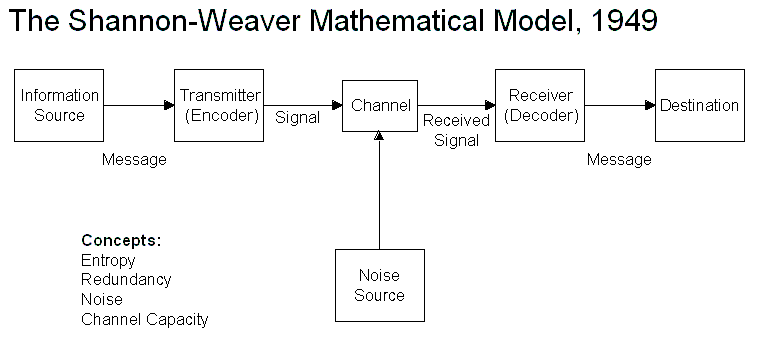
Visual designers face many problems while trying to create a strong visual message. I separate them into three categories that stem from the Shannon-Weaver model. They are listed below.
•Comprehension Problems: Before the message has been generated, all you have is an information source, or facts. The interpreter of the facts could have simply misinterpreted the facts. That means your effort to visually solve a problem is flawed before its inception. The same is true with the opposite end of the model. The person who is receiving the message just may not “get it”.
•Transmitter Problems: You could have a strong message, but deliver it the wrong way. If you’re selling a quality product, would you really want to print it on cardboard paper?
•External Problems (Noise): You could have done everything perfectly, but things beyond your control could interfere with the message being delivered the way that you intend. Imagine sending a beautiful mailer to constituents, asking them to vote for a candidate. What if the postal worker had to deliver the mailers during a storm, and they got to the constituents damp, dirty and wrinkly?
These are just a sampling of situations you have to think about while designing and communicating.
Digital vs. Analog
From the start Don Norman brings up the point that we, as humans, do not belong in a world of technology. Humans are ever changing and evolving while machines are precise and cold with constant need of human repair. While the opposite worlds attract like magnets, they are becoming too tightly stuck together, hindering the natural human instincts we once knew so well. We have created a world not like the one we know by nature and as it grows we become more involved in it.
There is no doubt that technology is extremely useful. For example this class requires so much reliance on machines alone. Writing on the blog with computers, the students' transportation to class/school, and the use of a screen in class for the students to look to for reference. It's everywhere, making our lives easier all the time. It's not until people start to completely rely on technology for things we could otherwise do ourselves that it starts to become obvious we are hurting ourselves. Designers that understand this could help people find the middle ground. Technology that only aids and does not complete every given task we face. There must be a gray area where people can control their use of technology rather than drown in it.
Is technology evolving faster then we are?
It doesn't take long for the latest and greatest computer that you just bought to become outdated. With the rate technology is improving we're all going to be left behind pretty soon. Society can't change into digital human beings and digital technology sure isn't going to go back to analog. So when do we realize what we're doing to ourselves?
As designers we need to be aware of our analog audience and make the user experience as easy as possible. We need to make the digital world more flexible to meet the needs of our audience. Ideally a designer should be able to find a perfect balance between analog and digital, but that balance is different for each person who experiences the end product. Who do you make your target audience so you can satisfy the most people?
It is easy to see through the generations that not all people have been able to keep up with digital technology. Generations who grew up without a computer being a standard piece of technology have a harder time adapting and then keeping up with the progressions. There has to come a point in time when people get fed up with constantly having to keep up with technology.
As designers we need to be aware of our analog audience and make the user experience as easy as possible. We need to make the digital world more flexible to meet the needs of our audience. Ideally a designer should be able to find a perfect balance between analog and digital, but that balance is different for each person who experiences the end product. Who do you make your target audience so you can satisfy the most people?
It is easy to see through the generations that not all people have been able to keep up with digital technology. Generations who grew up without a computer being a standard piece of technology have a harder time adapting and then keeping up with the progressions. There has to come a point in time when people get fed up with constantly having to keep up with technology.
Shannon-Weaver Model
The Shannon-Weaver model has been adopted into social sciences such as teaching and psychology. The model, regarding digital media, in theory should have worked out well because of the simplistic design of the model. I do agree with Adam about how the model has become less relevant in the in the modern day with the advancement in computers. The model also loses ground because of all the different ways people today communicate with each other, it is not just emails anymore other ways to send information has developed.
The model, if updated, could make more sense for the digital media age now. However, the model would work wonders in policy issues and the government. It would help with communication problems and be a more effective way of communication.
Subscribe to:
Comments (Atom)